

 Send Email
 Whatsapp


Introduction
For B2B solar buyers, connectors are no longer minor balance-of-system parts; they are high-risk, performance-critical components that influence safety, uptime, compliance, and long-term project returns. As utility and commercial PV systems move toward higher-voltage designs, selecting the right MC4-compatible connectors requires more than checking price and current ratings. Buyers need to understand interoperability risks, material quality, certification standards, environmental durability, and supplier consistency across large deployments. This guide outlines the key technical and procurement considerations for 2026, helping EPCs, developers, and sourcing teams make informed connector decisions that reduce failure risk, protect warranties, and support reliable asset performance.

Why Solar Connectors and MC4 Are a Strategic Procurement Priority
In the rapidly expanding landscape of commercial and utility-scale photovoltaic (PV) installations, procurement professionals must treat solar connectors as critical infrastructurerather than commoditized hardware. As modern solar arrays transition toward 1500V DC architectures to maximize energy yield and reduce cabling costs, the electrical and mechanical demands placed on interconnection points have escalated significantly.
Failing to prioritize high-quality components at the procurement stage exposes developers and engineering, procurement, and construction (EPC) firms to severe operational and financial liabilities. The MC4 standard has emerged as the dominant interface in this sector, but navigating the procurement of these components requires a deep understanding of their strategic impact on the overall lifecycle of a solar asset.
Impact on system uptime and warranty risk
Solar Connectors represent the most vulnerable points in any PV architecture. Industry data indicates thatcross-mating incompatible connectors or utilizing substandard components accounts for over 70% of connector-related failures. These failures often manifest as increased contact resistance, leading to thermal events, localized melting, arc faults, and ultimately, catastrophic roof or ground-mount fires.
Beyond severe safety hazards, component failure directly impacts system uptime and return on investment. A single degraded connector can take an entire 20-panel string offline, resulting in immediate power generation losses and triggering costly Operations and Maintenance (O&M) truck rolls that average $300 to $500 per incident. Furthermore, utilizing non-certified or mismatched connectors frequently voids both module and inverter warranties, shifting the financial burden of replacements entirely onto the asset owner.
Key product definitions and connector categories
The term MC4 refers to "Multi-Contact 4-millimeter," a standard originally developed by Stäubli that has become the ubiquitous connection method for modern solar panels. These components utilize a 4mm diameter contact pin and are designed for secure, weather-resistant snap-in mating. While the original proprietary design holds specific global certifications, the market is saturated with "MC4-compatible" alternatives.
Connectors are generally categorized by their supported wire gauges—typically 4mm² (12 AWG) or 6mm² (10 AWG)—and their intended application environment. Branch connectors (Y or T types) parallelize circuits, while panel-mount receptacles integrate directly into inverter housings. Procurement teams must differentiate between authorized, patented designs and third-party replicas that may not adhere to the exact dimensional tolerances required for secure mating over a 25-year operational lifespan.
Technical, Compliance, and Performance Criteria for Evaluating Solar Con
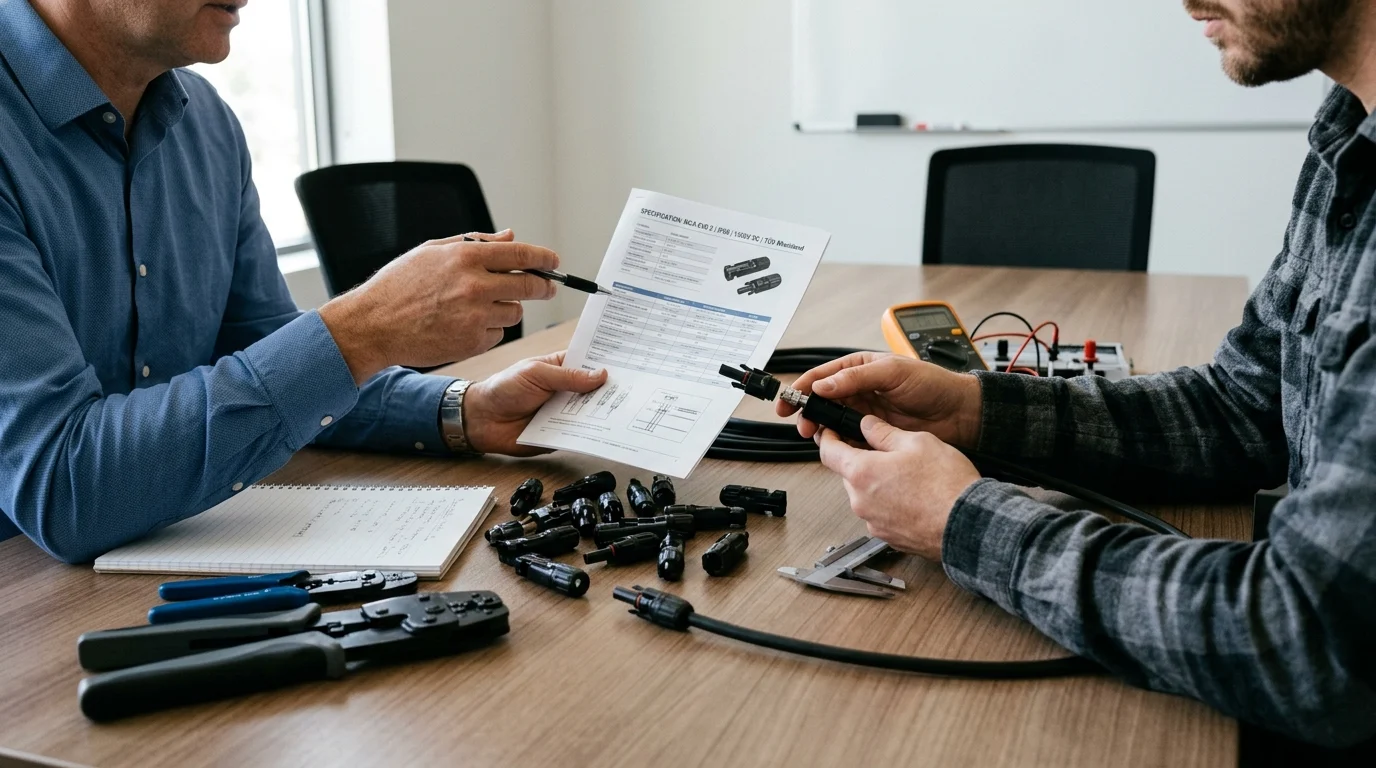
Evaluating solar connectors requires a rigorous technical framework that goes beyond basic dimensional compatibility. With bifacial modules and high-power density panels pushing string currents significantly higher than previous generations, the baseline specifications for interconnects must be closely scrutinized by engineering and procurement teams.
Current rating, durability, and compatibility
Standard connectors typically handle 30A, but modern high-output modules necessitate components rated for 50A to 65A to prevent dangerous overheating. Durability is dictated by environmental protection capabilities; IP68 ratings are mandatory for long-term outdoor exposure, ensuring complete protection against dust ingress and continuous water submersion. Compatibility remains a critical issue; cross-mating different brands, even if labeled "MC4-compatible," introduces micro-gaps that elevate contact resistance and accelerate degradation.
| Feature | Standard MC4 | High-Current MC4 |
|---|---|---|
| Current Rating | Up to 30A | 50A - 65A |
| Voltage Rating | 1000V DC | 1500V DC |
| Typical Wire Gauge | 4mm² / 12 AWG | 6mm² - 10mm² / 10-8 AWG |
| Contact Resistance | < 0.50 mΩ | < 0.25 mΩ |
Certification, testing, and traceability requirements
Regulatory compliance ensures long-term viability and grid safety. Components must carry rigorous certifications such as IEC 62852 for the European market and UL 6703 for North America. These standards mandate survival through extreme environmental stress tests, including 1000 hours of damp heat exposure and severe thermal cycling.
Traceability is equally vital for risk mitigation. Suppliers must provide batch testing data, material certificates, and clear lot numbers stamped on the components. A rigorous quality control process will verify that contact resistance remains strictly below the 0.25 mΩ threshold after prolonged environmental exposure, ensuring that the connector does not become a bottleneck for power transmission.
How B2B Buyers Should Source, Compare, and Select Solar Connectors
Strategic sourcing of PV interconnects requires balancing upfront capital expenditures with long-term reliability. B2B buyers must move beyond transactional purchasing based solely on unit price and establish robust supplier qualification protocols. Consulting a comprehensive solar connectors B2B buyers guide can streamline this complex evaluation process and align procurement strategies with engineering requirements.
Commercial comparison points and supplier evaluation
Key commercial metrics for evaluating suppliers include Minimum Order Quantities (MOQs), lead times, and volume pricing tiers. Tier-1 manufacturers typically require MOQs ranging from 10,000 to 50,000 units for custom or high-spec orders, with lead times extending from 4 to 8 weeks depending on global copper supply chains and factory utilization rates.
Pricing bands fluctuate based on raw material costs, plating quality (e.g., tin versus silver-plated copper), and IP ratings. Standard volume contracts generally see pricing between $0.45 and $1.20 per mated pair. However, buyers must calculate the Total Cost of Ownership (TCO); saving $0.20 on a cheaper connector is rapidly negated if it causes a $5,000 string outage or a fire-related liability claim.
Building a practical selection checklist
A robust procurement checklist must encompass factory audits, automated crimping validation, and raw material verification. Buyers should specifically demand proof that housings are molded from high-grade Polyphenylene Ether (PPE) or Polyphenylene Oxide (PPO) plastics, which offer superior UV resistance and a broad operating temperature range of -40°C to +85°C.
Furthermore, procurement teams should mandate third-party laboratory reports validating mechanical parameters, such as a minimum insertion force of 50N and a pull-out strength exceeding 400N. Ultimately, selecting a supplier with proven manufacturing consistency, rigorous end-of-line testing, and transparent supply chain practices shields EPCs and asset owners from the disproportionate costs of post-installation remediation.
Key Takeaways
- The most important conclusions and rationale for Solar Connectors,MC4
- Specs, compliance, and risk checks worth validating before you commit
- Practical next steps and caveats readers can apply immediately
Frequently Asked Questions
Why are MC4 connectors a strategic purchase for EPCs and developers?
They directly affect uptime, fire risk, and warranty validity. One failed connector can disable a string and trigger costly O&M visits, so certified, traceable parts reduce lifecycle risk.
Can I mix different MC4-compatible connector brands?
Avoid cross-mating brands. Small dimensional differences can raise contact resistance, cause overheating, and void module or inverter warranties.
What ratings should B2B buyers prioritize in 2026?
For modern utility and commercial PV, prioritize 1500V DC, 50A–65A current capacity, IP68 sealing, and low contact resistance, especially for high-power modules.
Which certifications should solar connectors have for major markets?
Look for IEC 62852 for Europe and UL 6703 for North America. Ask suppliers for test reports, lot numbers, and batch-level quality records.
What should I request from a solar connector supplier before ordering?
Request certification documents, batch test data, material certificates, wire gauge compatibility, current/voltage ratings, and clear traceability markings on each lot.