

 Send Email
 Whatsapp


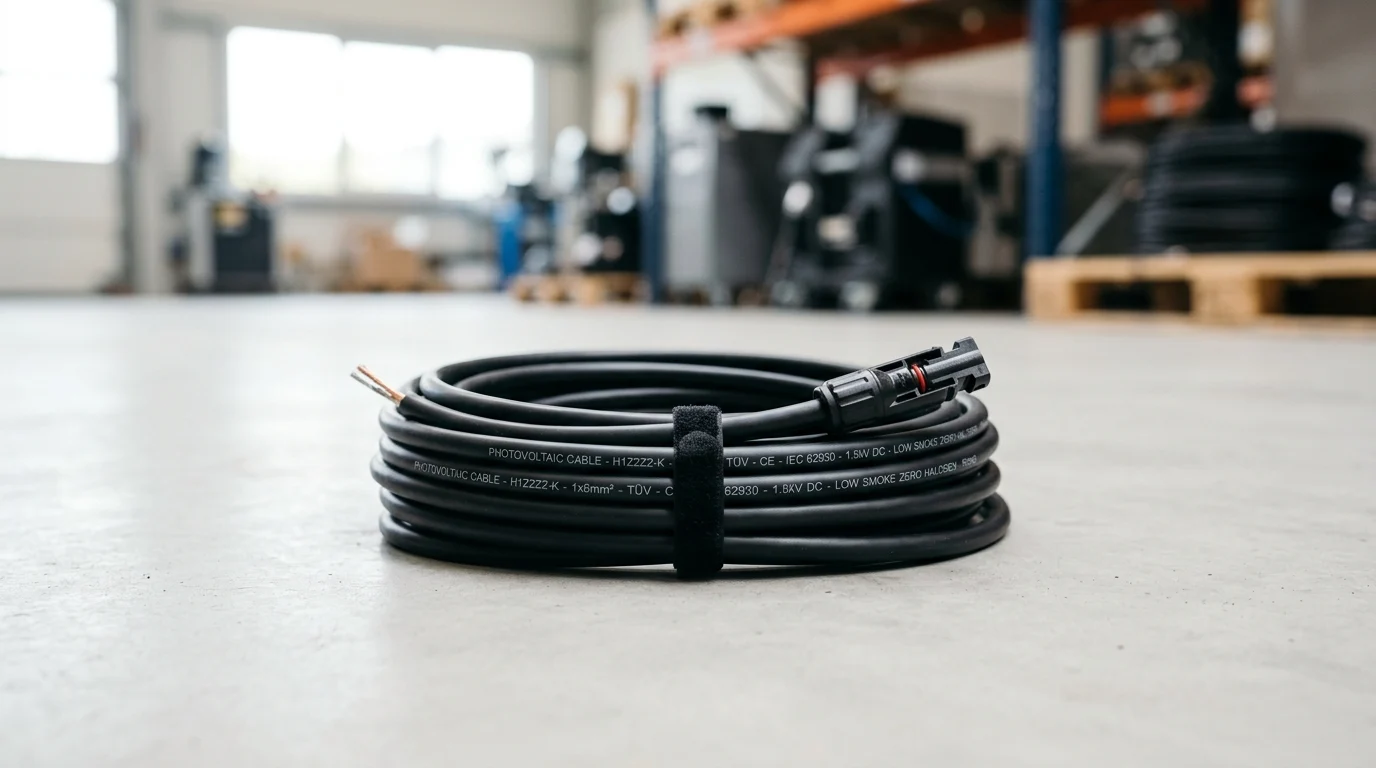
Choosing the wrong wire in a photovoltaic system is not a small specification error—it can affect energy yield, code compliance, and fire safety. Solar arrays operate for decades in direct sun, rain, wind, and extreme temperature swings while carrying high-voltage DC power, conditions that ordinary building wire was never designed to withstand. This article explains how Solar Cable differs from common electrical wire in insulation, UV resistance, weather protection, temperature ratings, standards, and expected service life. Understanding these differences helps installers, system owners, and buyers select wiring that supports a safer, longer-lasting PV installation.
Why Solar Cable Is Different from Ordinary Electrical Wire
A common and potentially dangerous error in photovoltaic (PV) system installation is the assumption that any standard copper wire will suffice for the entire array. The distinction between a specialized solar cable and ordinary electrical wire dictates not just the efficiency of power transfer, but the fundamental safety and longevity of the system. Using the incorrect wire type in the wrong location significantly increases the risk of system failure and safety hazards.
What Solar Cable Is Designed For
PV systems operate under harsh environmental conditions that can quickly degrade standard building materials. Solar cables are specifically engineeredto connect individual solar panels, combine them into larger arrays, and safely route high-voltage direct current (DC) power from the roof or ground mount to the inverter. They must withstand decades of direct sunlight, precipitation, and extreme thermal cycling. While dedicated PV Wire is the modern standard, USE-2 is a common code-permitted alternative for certain solar applications, whereas RHW-2 is rarely specified for modern PV arrays.
To meet strict regional industry standards—such as Ul 4703 in North America or EN 50618 in Europe—these specialized cables are rigorously tested to provide a functional lifespan of 25 to 30 years under continuous outdoor exposure. This durability is essential, as replacing degraded wires underneath a mounted solar array is labor-intensive and expensive.
What Ordinary Electrical Wire Is Designed For
In contrast, ordinary electrical wires, such as THHN, THWN, or NM-B (commonly known as Romex), are fundamentally intended for protected environments. Their primary job is to distribute alternating current (AC) power within the climate-controlled walls of residential or commercial buildings.
Because they are shielded from ultraviolet (UV) rays, excessive moisture, and extreme temperature fluctuations, they do not require heavy-duty defensive jacketing. Their standard polyvinyl chloride (PVC) insulation is cost-effective for indoor use but degrades rapidly when exposed to the elements. If mistakenly used outdoors without the protection of a sealed conduit, the plasticizers in standard PVC insulation can dry out. Depending heavily on the local climate and UV intensity, this can cause the wire to become brittle and crack within 3 to 5 years, exposing live copper conductors to the weather.
Key Differences Between Solar Cable and Ordinary Wire
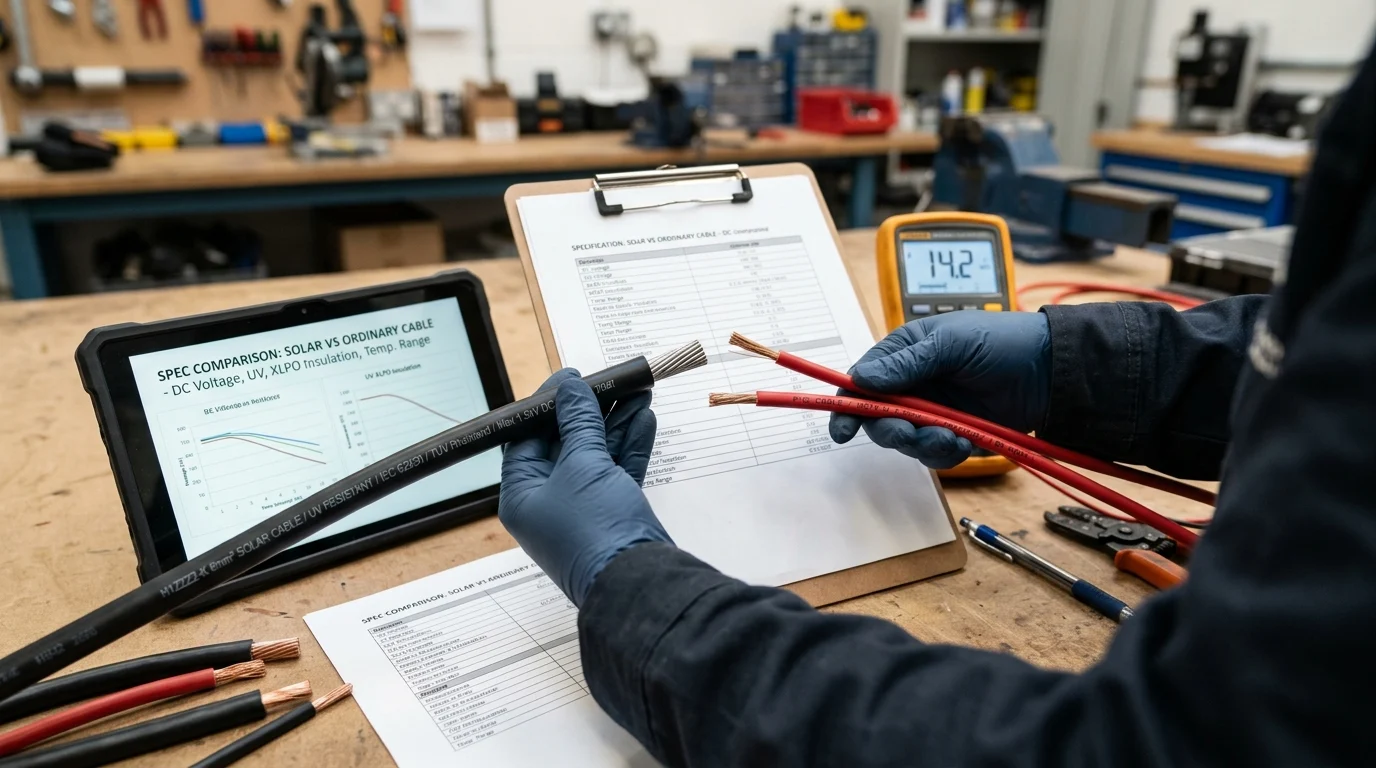
The structural and chemical differences between these two wire types become clear when examining their construction materials and performance thresholds side-by-side. It is important to look beyond the conductive copper core and focus on the jacketing materials and insulation ratings.
UV, Weather, and Temperature Resistance
Solar cables feature a robust, double-insulated construction utilizing cross-linked polyethylene (XLPE) or similar halogen-free compounds. This specialized jacketing provides built-in resistance to ultraviolet radiation, ozone degradation, and moisture penetration. It also handles a wide temperature range; a standard PV wire is rated to operate between -40°C and +90°C, with premium options rated for continuous operation up to 120°C, while short-circuit fault conditions can often withstand spikes up to 250°C.
Conversely, standard THHN wire is typically rated for a maximum of 90°C in dry locations and usually lacks the UV stabilizers required to survive direct sunlight. Furthermore, solar cables utilize fine-stranded tinned copper, which offers superior flexibility for routing behind panels and resists oxidation better than the standard-stranded or solid un-tinned (bare) copper found in ordinary wire.
Voltage Rating, Insulation, and Safety
Modern solar arrays operate at high DC voltages to minimize power loss over long distances. Consequently, a dedicated PV cable is generally rated for 600V, 1000V, or even 1500V DC, whereas standard household wires are usually capped at 600V AC.
Because DC arcs do not have a zero-crossing point like AC power, they are significantly harder to extinguish and pose a higher fire risk. The thick, dual-layer insulation on a PV wire is a critical safety feature designed specifically to prevent dangerous short circuits and ground faults. However, insulation alone cannot prevent arc faults; true arc-fault mitigation requires proper connectors, correct installation torque, and dedicated arc-fault protection devices.
| Feature | Solar Cable (PV Wire) | Ordinary Wire (e.g., THHN/THWN) |
|---|---|---|
| Insulation Material | Double-layer XLPE | Single-layer PVC or Nylon/PVC |
| UV & Weather Resistance | Excellent (Built-in) | Poor (Requires conduit outdoors) |
| Operating Temperature | -40°C to +90°C (up to 120°C continuous) | -10°C to +90°C (dry only) |
| Standard Voltage Rating | 600V, 1000V, or 1500V DC | Typically 600V AC |
| Conductor Type | Fine-stranded, tinned copper | Standard-stranded or solid un-tinned copper |
| Expected Outdoor Lifespan | 25+ years | 3 to 5 years (if unprotected) |
How to Choose the Right Cable for a Solar System
Selecting the correct wiring infrastructure requires careful calculation and a thorough understanding of the physical installation environment. A systematic, step-by-step approach ensures compliance with local electrical codes and maximizes the system's lifetime energy yield.
Cable Sizing and Installation Checks
Proper cable sizing is paramount to prevent excessive voltage drop and overheating. Keeping the system's total voltage drop below 3% is recommended to ensure maximum efficiency. For most residential solar panel interconnections, 10 AWG (roughly 5.3 mm²) or 12 AWG (roughly 3.3 mm²) solar cables are the industry standard, often substituted with their standard metric equivalents of 6 mm² and 4 mm², respectively.
A standard 10 AWG PV wire can safely carry up to 40 amps, though actual allowable ampacity depends heavily on the insulation temperature rating, ambient temperature, conduit fill, and bundling. Installers must consult local derating tables to determine the precise capacity for a given run. To size this correctly, installers calculate the maximum short-circuit current (Isc) of the solar array and multiply it by a continuous-use safety factor of 1.56 (as specified by governing standards like NEC 690.8) to determine the absolute minimum ampacity required. Additionally, physical connectors must be fully compatible with the cable's outer diameter to ensure a watertight seal.
Key Takeaways
- Use dedicated PV wire for exposed solar array connections because it is engineered for high-voltage DC, sunlight, moisture, and decades of outdoor service.
- Choose solar cable tested to recognized standards such as UL 4703 or EN 50618 when long-term rooftop or ground-mount reliability is required.
- Do not substitute ordinary THHN, THWN, or NM-B wire in exposed PV locations because standard PVC insulation can crack after 3 to 5 years outdoors.
- Check temperature ratings carefully, since typical PV wire can operate from -40°C to +90°C and premium options may support continuous temperatures up to 120°C.
- Account for replacement difficulty when selecting cable, because degraded wiring beneath mounted solar panels is expensive and labor-intensive to access.
Frequently Asked Questions
Can ordinary electrical wire be used for solar panels?
Ordinary wire such as THHN, THWN, or NM-B is not suitable for exposed PV array wiring because sunlight, moisture, and heat can degrade its insulation and create safety risks.
Why is solar cable more durable than standard wire?
Solar cable uses UV-resistant, weather-resistant insulation such as XLPE and is built for outdoor DC operation, thermal cycling, moisture exposure, and long-term rooftop or ground-mount use.
How long is solar cable expected to last?
PV wire tested to standards such as UL 4703 or EN 50618 is commonly designed for about 25 to 30 years of outdoor service in solar installations.
What happens if standard PVC-insulated wire is exposed outdoors?
UV rays and weather can dry out PVC insulation, making it brittle and cracked within about 3 to 5 years in harsh conditions, potentially exposing live conductors.
What temperature range can PV wire handle?
Standard PV wire is often rated from -40°C to +90°C, while premium solar cables may support continuous operation up to 120°C and short-circuit spikes up to 250°C.